
A postponed fixture needs its original time and event identity
A new kickoff time is not enough to interpret a postponed-event record. You need the original scheduled time, the time zone, the event identity and the applicable rule.
Without those fields, “moved to tomorrow” can hide a short delay, a different fixture or a change that falls under another condition.

Use the applicable terms rather than a universal deadline
The Smarkets general rules provide a named example: their exceptional-circumstances section distinguishes postponement, cancellation and changes of opponents or venue, with sports-specific rules able to override the general conditions. That structure is the lesson here, not a deadline borrowed for another operator.
This article deliberately does not assign a universal refund window. The rule attached to the accepted event and market must supply the relevant limit and exceptions.
Calculate elapsed time from the original schedule
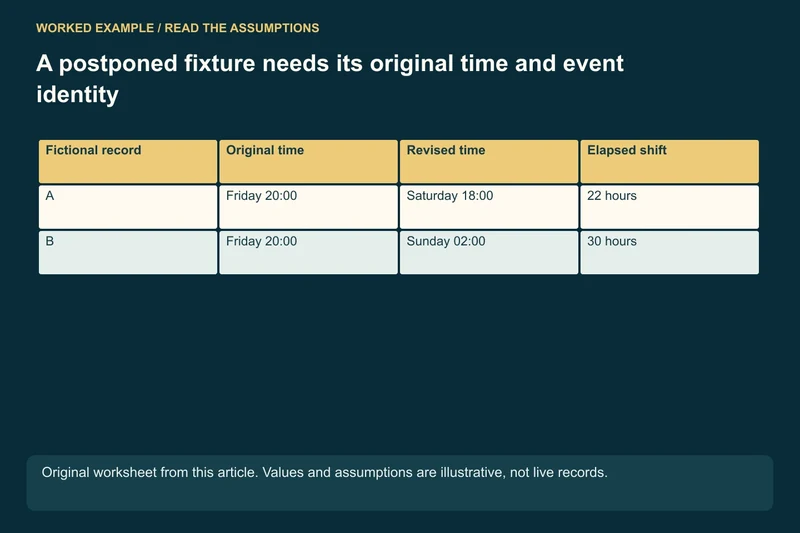
| Fictional record | Original time | Revised time | Elapsed shift |
|---|---|---|---|
| A | Friday 20:00 | Saturday 18:00 | 22 hours |
| B | Friday 20:00 | Sunday 02:00 | 30 hours |
Both records could be described loosely as a weekend postponement, but their shifts differ by eight hours. These calculations do not decide whether either record stands or is void. That requires the actual policy threshold and any more specific rule.
Match the fixture before comparing the clock
Keep the competition, teams, event reference and original date together. A rescheduled fixture between the same clubs is not automatically interchangeable with another match those clubs play later. Changed opponents or a substituted event create an identity question before they create a time calculation.
Also separate the kickoff time from the time a message was sent. A notification at 11:00 saying the fixture has moved to 18:00 does not make 11:00 the original schedule. Preserve the original accepted record instead of replacing it with the latest listing.
A short worksheet makes the unresolved point clear
Record the accepted event ID, original start with zone, revised start with zone, official event status and the applicable rule text. Then calculate the shift and check whether a sports-specific condition changes the interpretation. If a zone or original time is missing, mark the elapsed time unresolved rather than assuming local midnight.
This method organizes an existing event record; it does not predict the match or promise a refund. A useful question is “Which original schedule and specific condition were used?” That is more precise than assuming every postponed match follows the same treatment.
The taya365 homepage brings together the site’s other reading topics.
Source-based editorial research and original examples. Sources checked 9 October 2026. No real-money play or account transaction was performed for this article.