
An away-first score feed can describe the same match result
Published — UTC

Two feeds can print opposite-looking scores because they list the teams in opposite order. Compare each number with its team label before calling the results inconsistent.
The same invented match in two formats
| Feed | First listed team | Printed score | Second listed team |
|---|---|---|---|
| A | Harbour | 2–1 | Valley |
| B | Valley | 1–2 | Harbour |
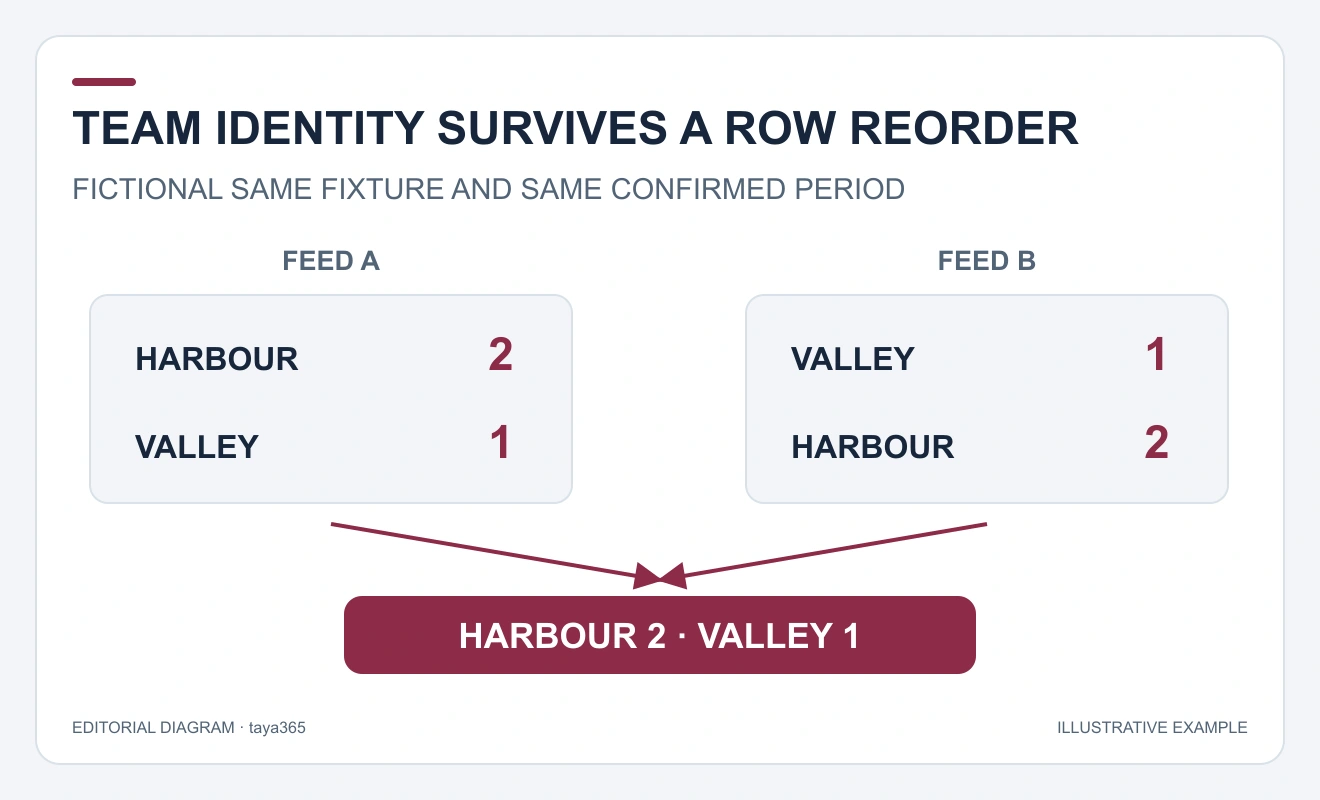
Both assign Harbour two goals and Valley one. Neither says Harbour lost. Copying B’s “1–2” into a Harbour-first worksheet without changing the order would reverse the result.
A normalization row
Retain the fixture ID, period, team identifiers and each team’s score. Then write both feeds into the same agreed order. Home/away status is another field; the first team displayed is not sufficient proof of it, particularly when an interface sorts by a selected team.
The British result-determination reference provides context for rule-bound event settlement. It does not designate either fictional feed as an official result source.
Do not normalize away a real disagreement
If one feed assigns Harbour three goals after team labels and periods are aligned, the sources disagree on a value. Preserve the two versions and their timestamps. A half-time snapshot also cannot be substituted for a full-time result merely because its team order matches.
Normalize values without changing their owners
Represent each feed as the same pair of assignments: Harbour → 2, Valley → 1. A Harbour-first output can then be written as 2–1 for either source. This operation changes display order, not the recorded goals. Keep the raw feed alongside the normalized record so the transformation remains auditable.
From Harbour’s perspective, goal difference is 2 − 1 = +1. Using feed B’s first number as Harbour’s score would instead calculate 1 − 2 = −1. The team labels determine which subtraction is meaningful; visual position does not.
The total is an insufficient cross-check
Both the correct mapping and its mistaken reversal sum to three goals. A total-only check therefore passes even after the winner has been reversed. Compare the team-to-score pairs, the period and the event identity, not just the sum. Goal difference can help expose the mistake only after its reference team is fixed.
Separate home status and display order
A selected-team view may put an away side first, and a neutral venue does not by itself identify the competition’s designated home team. Store home/away designation from the fixture record in its own field. Do not infer it from shirt colour, left-hand position or the two fictional names used here.
Do not merge two fixtures with similar names
A reserve side, women’s team or later return fixture can share part of a displayed name. Stable team and fixture identifiers, competition and scheduled time help establish whether the records can be compared. If one aligned source says Harbour 3 and another says Harbour 2, keep that disagreement visible with source status and revision timestamps. Reordering rows cannot explain or repair a changed value.